
Hermes Agent

In the science fiction movies I watched as a kid, people talked to computers in natural language. Now it is real. Some months ago I wrote about Ollama. Since then, the way I use AI has changed completely: now almost everything goes through Hermes Agent.
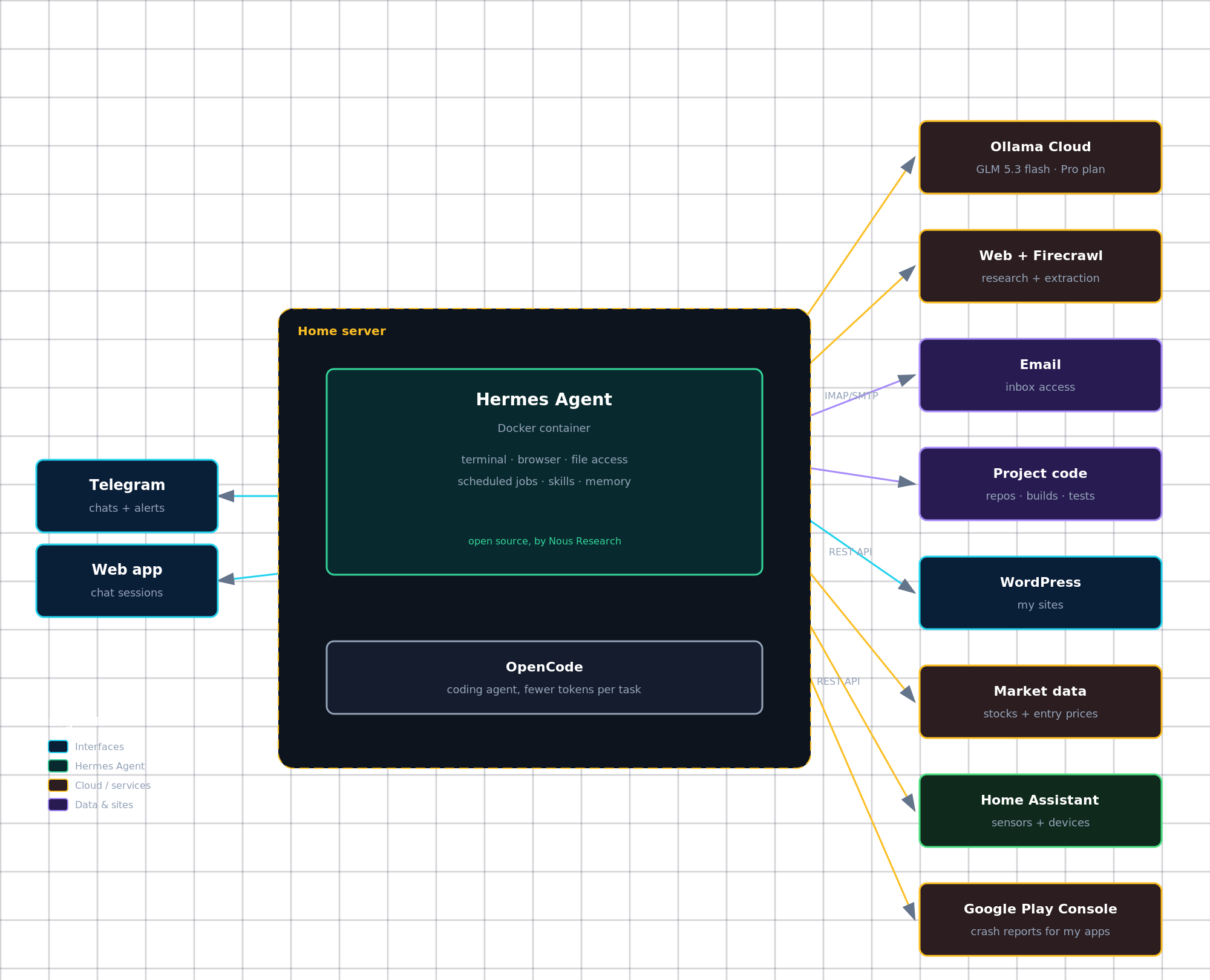
Hermes is an open source personal AI agent from Nous Research. It runs on your own machine or server, you talk to it from Telegram (or other channels), and it has real tools: a terminal, a browser, file access, scheduled jobs. I run it in a Docker container on my home server, together with the rest of my self-hosted services. It connects to Ollama Cloud for the models: I am paying for the Ollama Cloud Pro subscription and using GLM 5.3 flash; before that I was on GLM 5.2.
It replaced my searches and my chatbots
I don’t open ChatGPT or Claude anymore. When I need something, I ask Hermes from Telegram or from its web interface, and many searches that went to Google now go to Hermes. It searches the web, reads the pages, and answers with sources.
It replaced my local AI tools
I was running Open WebUI in Docker as my local chat interface, and I also played with OpenClaw. Hermes replaced both for my daily use.
What it actually does for me
- Web research: I set up the Firecrawl integration, so it can investigate on the web and extract content from pages that block plain fetching.
- Email: it has access to my inbox. It can check for important messages, summarize long threads and draft replies.
- Voice: you can talk to it instead of typing. It transcribes the voice messages you send it on Telegram, and it also has a push-to-talk mode where you hold a key, speak, and the transcript goes to Hermes as a message. It can speak its replies out loud too.
- Financial advisor: it keeps track of my portfolio and does financial analysis of the stocks I am interested in, suggesting entry prices. It sends me a Telegram message when one hits its target.
- Scheduled jobs: any of these can run on a schedule, alone, while I am doing something else.
- WordPress: it manages my WordPress sites: publishing and editing posts directly from the chat.
- Home Assistant: it is connected to my Home Assistant instance. It can query the sensors and control the devices: from the chat I can ask for the room temperatures, the CO2 level or the car battery, turn lights on and off, set the thermostat temperature, or send the lawnmower to mow.
- Google Play Console: it is connected to my Google Play Console with a service account. From the chat I can say “Search the Google Play Console for the latest crashes in my app X and apply the fixes to the code”, and it fetches the crash reports and applies the fixes to the code of that app.
- Code access: it has access to the code of my projects. When I ask it programming doubts, it writes example code to files, builds and runs them locally, and it can even download open source projects and test them on my server.
For coding I still use OpenCode
This is the honest part: Hermes has not replaced my coding agent. I am used to OpenCode, and it consumes fewer tokens per task. Hermes is my day-to-day assistant; when I sit down to write code, OpenCode is still my tool. They even run in the same Docker container on my home server, and Hermes can delegate some tasks to OpenCode, so the two work together.
A growing toolbox of skills
Hermes manages its own skills. It creates new ones when it learns a new workflow and updates them as things change, so its abilities grow with use.
Another thing I am realizing is that lots of custom “AI applications” can simply be replaced with a Hermes instance. Instead of installing a new tool for every use case, you just ask your agent, and the skills it already has or the ones it creates along the way cover it.
Final thoughts
One practical tip: create a new Telegram session from time to time. Sessions keep growing as you chat, and the token consumption of each message gets bigger and bigger, so starting fresh keeps costs down.
Hermes is the first agent that stuck for me. The tradeoff is the same one I mentioned with OpenClaw: you are giving an agent access to your email, your files and your terminal, so be careful with the permissions you grant. But having one assistant that reads my email, watches my stocks, searches the web and lives in Telegram is very convenient.